Quick answer: Yes, especially for searches about the company and its announcement. In BrandPush’s study of more than 2,000 releases, 91.6% reached Google’s first page for at least one related search, and 80.9% of monitored releases were cited by an AI engine on the first check. Broad category rankings on Google were rare (about 5%), and the study measures visibility, not traffic or sales.
We analyzed over 2,000 press releases across 2025 and 2026, tracking approximately 50,000 first-page Google rankings and more than 8,000 AI citations. Here’s what worked, what didn’t, and what businesses should realistically expect.
We tested searches and AI questions relevant to each release rather than unrelated or random keywords.
More than 9 in 10 press releases (91.6%) reached Google’s first page for at least one monitored search. Approximately 4 in 5 monitored releases (80.9%) received an AI citation on their first check, which usually took place on publication day.
Most Google rankings came from searches involving the company, its products, its people, or its announcement. AI engines showed a broader pattern: more than one in three monitored releases were cited for category-style questions that did not require someone to search for the company by name.
Where a release was published was associated with much larger differences than its length.
These results measure the visibility of published press release copies. They do not establish that distribution improved the company’s own website rankings, traffic, leads, or sales.
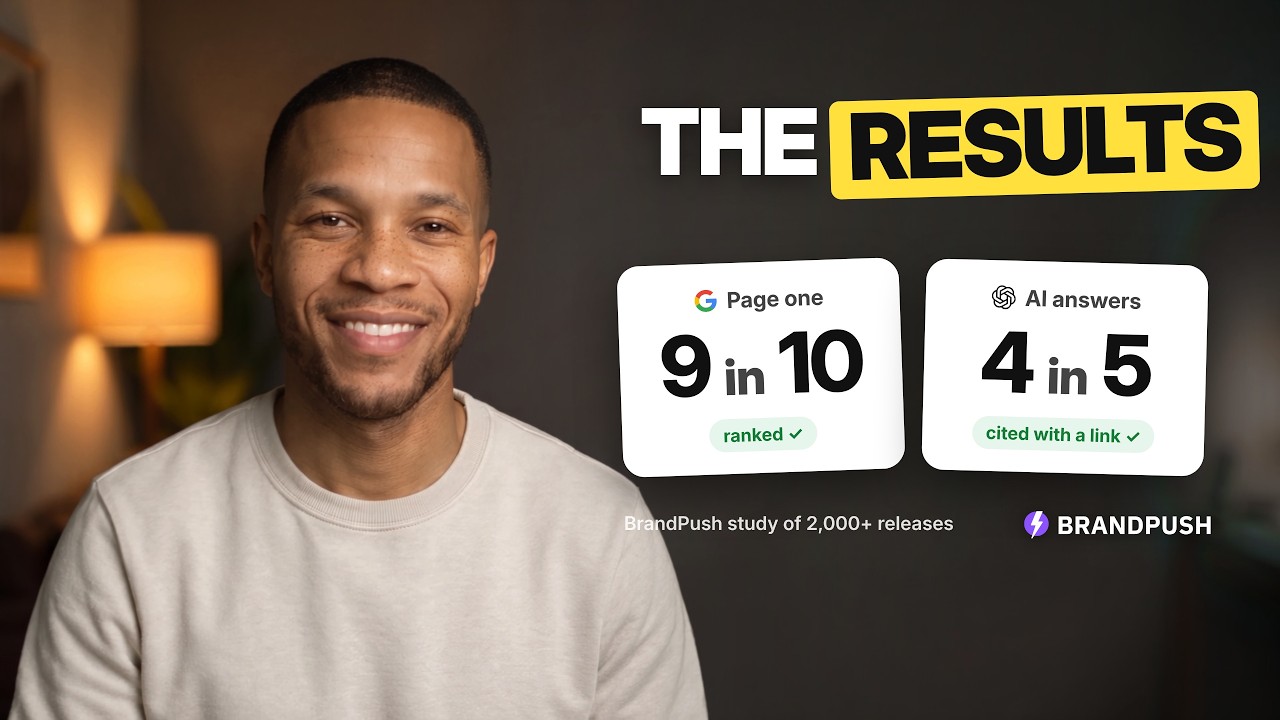
A walkthrough of the Google ranking, AI citation, outlet and package results covered below, presented by Miles, an AI-generated host. Watch on YouTube.
Key findings
| Finding | Result |
|---|---|
| Releases reaching Google’s first page | 91.6% |
| Releases achieving at least one top-three ranking | 85.2% |
| Releases achieving at least one #1 ranking | 75.3% |
| Median first-page rankings per release | 19 |
| First-page rankings appearing in the top three | 71% |
| Releases cited by AI on the first check | 80.9% |
| Releases cited for a question without the company name | 57.4% |
| Releases cited for a category-style question | 34.6% |
| Google first-page rate across current packages | 63.3% to 99.7% |
Google results are based on more than 2,000 releases. AI results are based on the monitored subset of more than 600 releases. Searches were related to each announcement; see the methodology and disclosure below.
Press releases are unlikely to put a company’s website at the top of Google for a highly competitive phrase such as “best CRM software.”
That does not mean they offer no search value.
Our findings show that published press releases regularly appear for branded and story-specific Google searches. They can also become sources for AI answers, including some questions from people who do not already know the company.
The important distinctions are:
-
What people are searching or asking about.
-
Which websites publish the release.
-
Whether success means visibility, a backlink, a recommendation, or a commercial outcome.
-
How the results are measured.
How we measured the results
This study covers more than 2,000 press releases distributed through BrandPush across 2025 and 2026.
After publication, each release was checked against its own list of up to 70 searches generated from the announcement. These searches covered:
-
The company and its brand name.
-
Products, services, and people mentioned in the release.
-
The announcement’s subject and important details.
-
Questions potential customers might ask.
-
Broader category questions related to the announcement.
AI engines were asked questions drawn from the same release-specific list.
An AI mention without a link was not counted. Searches were related to each announcement, not random keywords.
An example of the searches we tested
Imagine a fictional company called Northwind Bikes announcing a new electric bicycle.
| Search type | Example |
|---|---|
| Brand and product | Northwind Bikes electric bicycle |
| Brand and detail | Northwind Bikes new e-bike price |
| Category discovery | Which companies make electric bicycles? |
| AI question | Is Northwind Bikes a good electric bicycle brand? |
These examples are fictional and are not taken from customer data.
This method measures whether an announcement becomes discoverable through searches related to the company, its news, or its business category.
It does not measure performance across unrelated keywords or establish how the same release would perform for every possible search.
What we counted
-
Google ranking: A published copy of the release appearing in Google’s top 10 organic results.
-
AI citation: An answer from ChatGPT, Google AI Overviews, Google AI Mode, Perplexity, or Grok containing a link to a published copy of the release.
An AI mention without a link to the release was not counted as a citation.
These were distributed press release copies hosted by the listed publishing domains. They should not automatically be interpreted as independently researched editorial coverage.
The dataset
| Measurement | Total |
|---|---|
| Press releases analyzed | More than 2,000 |
| Press releases checked for AI citations | More than 600 |
| Google first-page rankings | Approximately 50,000 |
| AI citations | More than 8,000 |
| Outlets appearing on Google’s first page | 193 |
| Outlets cited by AI | 126 |
Each Google ranking represents a unique release and search combination. Each AI citation represents a unique release, engine, and question combination.
Free and internal test orders were excluded. Completed releases with zero recorded results remained in the dataset.
Our database retains searches that produced recorded results rather than every search that was tested. We can therefore report release-level outcomes and analyze the searches that produced results, but we cannot calculate a success rate across every query tested or reconstruct the complete distribution of tested queries.
All customer results are aggregated.
You can see how publication links, rankings, and citations are presented in BrandPush’s Ultimate sample report.
Do press releases rank on Google’s first page?
Yes. More than 9 in 10 releases reached Google’s first page for at least one announcement-related search.
Most successful rankings also appeared near the top.
Google ranking performance
| Ranking achieved | Share of releases |
|---|---|
| At least one first-page ranking | 91.6% |
| At least one top-three ranking | 85.2% |
| At least one #1 ranking | 75.3% |
The median release appeared on page one for 19 searches, while the average was 21.6. The top quarter achieved at least 37 first-page rankings.
Where did they rank?
| Google position | Share of first-page rankings |
|---|---|
| #1 | 34.9% |
| #2 | 22.3% |
| #3 | 14.2% |
| #4 to #5 | 15.1% |
| #6 to #10 | 13.6% |
More than seven in ten recorded first-page rankings appeared in the top three.
That indicates that successful copies were not merely indexed. For many of the searches monitored, they appeared prominently.
But the type of search matters.
Branded searches produced most Google rankings
Approximately 92% of recorded first-page rankings came from searches involving the company name, products, people, or related branded terms.
This is unsurprising because the monitoring process deliberately tested searches related to each announcement.
Importantly, 92% describes the share of successful rankings. It does not describe the share of all searches tested because the database does not retain every unsuccessful query.
Branded visibility can still be commercially useful.
Someone might discover a company through an advertisement, referral, event, or social post and then search for it before buying. A published news copy gives that person another source of information beyond the company’s website and social profiles.
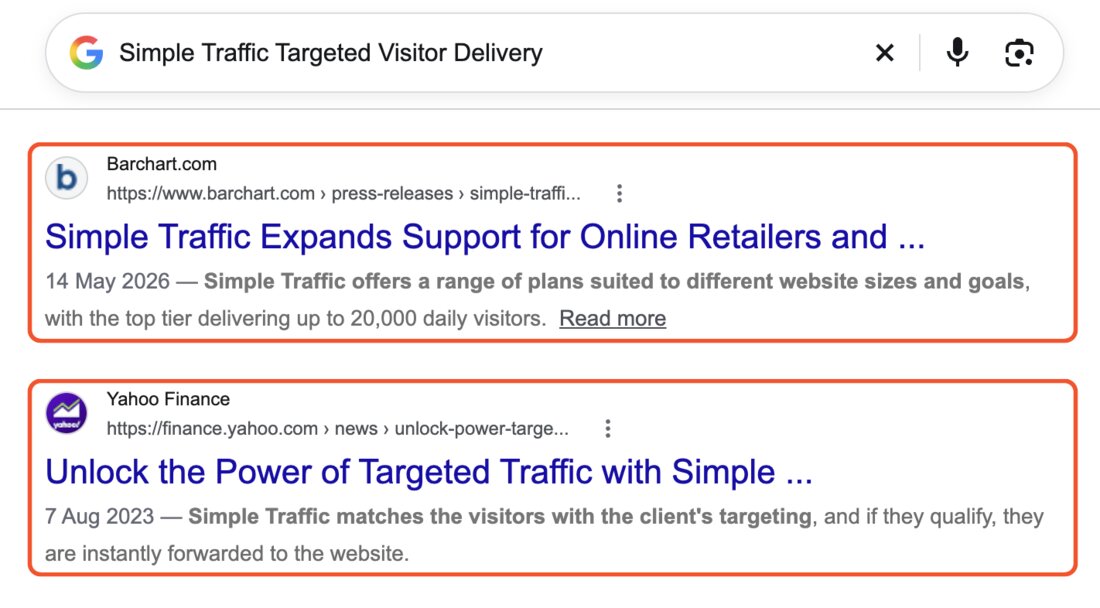
A branded search for Simple Traffic. The Barchart and Yahoo Finance copies of its releases rank first and second. This example is shown in BrandPush's Ultimate sample report.
What about searches without the company name?
Press releases also appeared for non-branded searches, although less consistently.
-
50.6% of releases reached page one for at least one search without the company name.
-
39.4% reached the top three for at least one such search.
-
Approximately 5% reached page one for a broader category-style search, such as a “best provider” or “which company” query.
Share of releases reaching Google’s first page for at least one search of each type. Source: BrandPush study of more than 2,000 releases.
That final figure is important.
A press release is unlikely to outperform established websites for a highly competitive keyword such as “best accounting software.”
The strongest observed Google opportunity was branded and story-specific visibility, not broad category rankings.
AI engines produced a different pattern for some broader discovery questions.
Do ChatGPT, Google AI, and Perplexity cite press releases?
Yes. Approximately four in five monitored releases received at least one AI citation on their first check for questions related to their announcements.
The first check usually occurred on publication day.
The exact first-check rate was 80.9%, increasing to 81.7% when subsequent checks were included.

Asked “What is simple traffic?”, Perplexity links the release copy on Business Insider’s markets section twice in its answer and lists it as the first source. This example is shown in BrandPush's Ultimate sample report.
Which AI engines cited releases?
| AI engine | Releases cited at least once | Share of recorded AI citations |
|---|---|---|
| Google AI Mode | 63.2% | 35.7% |
| Google AI Overviews | 53.7% | 20.4% |
| ChatGPT | 50.1% | 12.4% |
| Perplexity | 47.7% | 29.3% |
| Grok* | 14.8% | 2.3% |
Grok was monitored only through September 2026, so its results cover a shorter period. Package- and engine-level sample sizes varied within the monitored subset.
Google AI Mode and AI Overviews generated approximately 56% of all recorded AI citations.
Perplexity contributed more than twice as many individual citations as ChatGPT, even though ChatGPT cited a slightly higher percentage of releases.
This distinction matters. An engine can cite fewer releases overall while citing some of those releases across a larger number of questions.
AI citations frequently came from question-style searches
Nearly three in four AI citations (72%) came from question-style searches.
Questions producing AI citations averaged 8.1 words, compared with 5.7 words for searches producing Google rankings.
A useful press release naturally answers questions about:
-
Who was involved.
-
What happened.
-
When and where it happened.
-
What the business provides.
-
Why the announcement matters.
Clear answers to those questions give an AI engine information it can reference. They do not guarantee that a release will be cited. Our guide to answer engine optimization covers how AI search picks its sources.
AI citations went beyond branded questions
This was one of the most commercially interesting findings.
| AI discovery measurement | Result |
|---|---|
| Citations from questions without the company name | 27% |
| Releases cited for at least one question without the company name | 57.4% |
| Releases cited for a category-style question | 34.6% |
More than one in three monitored releases received a citation for a category-style question.
These included questions along the lines of:
-
“Which companies offer this service?”
-
“Who are the top providers in this city?”
-
“What are the best options for this product?”
These are examples of query types, not disclosed customer searches.
A person searching for a company by name already knows it exists. Someone asking about providers in a category might not.
That creates a potential discovery opportunity, but an important distinction remains: a citation is not necessarily a recommendation. We measured whether an AI answer linked to a published copy, not whether it described the business positively or encouraged someone to buy.
AI discovery versus traditional Google rankings
| Discovery measurement | Releases achieving it |
|---|---|
| Google first page for a category-style search | Approximately 5% |
| AI citation for a category-style question | 34.6% |
Different measurements, not directly comparable probabilities: one is a top 10 Google ranking, the other a link in an AI-generated answer. Source: BrandPush study.
These are different measurements, not directly comparable probabilities.
One measures whether a release appeared in Google’s top 10 organic results. The other measures whether an AI-generated answer linked to a release.
Even with that qualification, the contrast shows that AI engines used press releases for broader category questions more often than the releases ranked on Google for similar query types.
Google rankings and AI citations overlapped
We found that 53.8% of recorded AI citations came from questions where the same release also appeared on Google’s first page.
This does not prove that a high Google ranking caused the AI citation.
It does show that the same published copy can contribute to visibility across both traditional search results and AI-generated answers.
Which news websites generated the most visibility?
Not all publishing outlets produced equal results.
The study recorded first-page Google rankings from 193 outlets and AI citations from 126 outlets. The tables below show the success rate among releases published on each listed outlet rather than each outlet’s share of all results.
Top outlets for Google rankings
| News outlet | BrandPush Packages | Ranked on page one | Average position |
|---|---|---|---|
| markets.businessinsider.com | Ultimate, Authority | 86.5% | 2.7 |
| finance.yahoo.com | Optional Addon | 84.3% | 3.0 |
| barchart.com | Ultimate | 64.7% | 3.2 |
| bignewsnetwork.com | Ultimate, Authority, Growth | 37.3% | 3.7 |
| digitaljournal.com | Not currently offered | 36.1% | 2.9 |
| streetinsider.com | Ultimate, Authority | 23.9% | 3.7 |
Ranked on page one: share of releases on each outlet reaching Google’s first page. Average position: placement on that page, with 1 highest. Yahoo Finance carried 83 releases.
Business Insider’s markets section and Yahoo Finance each produced a first-page result for more than eight in ten releases they carried.
The successful results also tended to appear near the top. Average positions across the listed outlets ranged from 2.7 to 3.7.
Yahoo Finance’s rate should be interpreted alongside its smaller sample of 83 releases. A high observed percentage from a smaller group carries more uncertainty than a similar rate based on a much larger group.
For how placements on these two outlets work, see our guides to getting featured on Yahoo Finance and getting featured on Business Insider.
Top outlets for AI citations
| News outlet | BrandPush Packages | Cited by AI | Non-branded questions |
|---|---|---|---|
| finance.yahoo.com | Optional Addon | 99.5% | 24% |
| markets.businessinsider.com | Ultimate, Authority | 96.9% | 27% |
| ipsnews.net | Ultimate, Authority | 57.4% | 33% |
| bignewsnetwork.com | Ultimate, Authority, Growth | 54.5% | 30% |
| streetinsider.com | Ultimate, Authority | 52.7% | 16% |
| barchart.com | Ultimate | 40.3% | 27% |
| markets.financialcontent.com | Ultimate, Growth | 24.2% | 31% |
| apnews.com | Ultimate, Authority | 15.0% | 37% |
Cited by AI: share of releases on this outlet cited by an AI engine. Non-branded questions: the share of that outlet’s citations that came from questions not naming the company.
Business Insider’s markets section produced an AI citation for 96.9% of monitored releases published there.
Yahoo Finance had the highest rate at 99.5%. That figure comes from a much smaller group of monitored releases, so it carries more uncertainty than Business Insider’s.
The non-branded column provides another useful distinction. Depending on the outlet, between 16% and 37% of citing questions did not name the company.
These results do not prove that AI engines inherently trust one outlet more than another. Outlet performance can also reflect the releases published there, the questions tested, timing, and differences in monitoring coverage.
They do show why placement quality can matter more than the raw number of sites in a distribution package. Different outlets produced markedly different Google ranking and AI citation rates.
You can review BrandPush’s current publishing networks to see which outlets are included.
How did results differ by distribution package?
Results differed substantially by package.
In this observational dataset, package choice was associated with one of the largest performance gaps in the study.
BrandPush currently offers Access, Growth, Authority, and Ultimate. Each uses a different publishing network.
Google results use more than 2,000 releases; AI results use the monitored subset of more than 600. Observational comparison, not a controlled experiment. Source: BrandPush study.
Google results by package
| Package | Reached page one | Achieved #1 | Median first-page searches | Sample report |
|---|---|---|---|---|
| Access | 63.3% | 39.5% | 1 | View Access sample report |
| Growth | 92.7% | 70.4% | 8 | View Growth sample report |
| Authority | 99.7% | 92.5% | 31 | View Authority sample report |
| Ultimate | 99.3% | 91.9% | 34 | View Ultimate sample report |
AI results by package
| Package | Cited by AI | Median AI citations | Cited by 3+ engines |
|---|---|---|---|
| Access | 37.9% | 0 | 1% |
| Growth | 89.1% | 7 | 44% |
| Authority | 100% | 20.5 | 83% |
| Ultimate | 100% | 23 | 85% |
AI results use the monitored subset of more than 600 releases. The full study also includes two retired packages. Package-level sample sizes varied and should be considered when interpreting percentages of 100%.
The observed differences were substantial:
-
Access: Approximately six in ten releases reached Google’s first page, while fewer than four in ten monitored releases received an AI citation.
-
Growth: More than nine in ten reached Google’s first page, and nearly nine in ten monitored releases were cited by AI.
-
Authority and Ultimate: Virtually every release reached Google’s first page, and every monitored release received at least one AI citation.
Higher-tier packages include major financial news websites that contributed heavily to the recorded results.
However, Authority and Ultimate performed similarly for rankings and citations. The larger Ultimate network did not produce a comparable increase in these particular measurements.
These are observational comparisons, not a controlled experiment. Package selection, release characteristics, customer differences, publication timing, and the outlet network may all influence the results.
The data supports an association between stronger publishing networks and stronger observed outcomes. It does not establish that package choice alone caused the difference.
Does a longer press release help?
Much less than many businesses might expect.
Within the same package, length had little apparent relationship with Google rankings.
For Authority, the median was 31 first-page rankings, whether a release was short, regular, long, or customer-written.
Longer releases sometimes appeared to perform differently across the full dataset, but they were also more likely to be purchased with higher-tier packages. Much of the apparent length difference diminished when package level was considered.
This does not mean writing quality is unimportant. We did not test writing quality independently.
It suggests that adding words by itself is less important than publishing clear information on outlets that search and AI systems surface. If you’re comparing providers, our guide to choosing a press release distribution service lists what to check.
Did our measured AI citation rate increase over time?
The first-check AI citation rate increased during the monitored period.
| Month | Releases cited on first check |
|---|---|
| July 2026 | 72% |
| August 2026 | 78% |
| September 2026 | 78% |
| October 2026 | 86% |
| November 2026, partial month | 92% |
The measured rate rose from 72% in July to 92% during the partial November period.
However, the monitoring system also improved during these months, including how it handled AI engine rate limits. Some of the increase may reflect better measurement rather than a genuine market-wide increase in citation frequency.
The table therefore does not prove that AI engines became 20 percentage points more likely to cite press releases.
It shows that citations remained common throughout the monitoring period and that the measured first-check rate increased.
We rechecked 20 Authority and Ultimate releases between 8 and 29 days after publication.
-
All 20 gained at least three new AI citations.
-
The median was 15.5 new citations.
This was a small follow-up sample and should not be generalized to every release or engine.
It nevertheless illustrates an important point: AI answers and their cited sources change.
AI visibility should be measured over time rather than treated as a permanent result from a single check.
Why do other studies and SEO guidance reach different conclusions?
Two major 2026 studies found that press releases represent a small share of everything AI engines cite.
That might appear to contradict BrandPush’s finding that approximately four in five monitored releases received a citation.
The studies use different questions, source definitions, and denominators.
What Muck Rack found
Muck Rack’s May 2026 Generative Pulse study analyzed more than 25 million links cited by AI engines.
Its reported findings included:
-
84% of citations came from earned and third-party sources.
-
27% came from journalism.
-
0.3% came from paid or advertorial content.
-
Press releases represented approximately 1% of citations in its research series.
Muck Rack’s October 2026 follow-up covered 207 million citations from more than 40 million AI responses. Earned and third-party sources still accounted for more than 84% of citations.
What BuzzStream found
BuzzStream’s The Role of News Publications in AI Citations analyzed 4 million citations generated from 3,600 prompts across 10 industries.
It found:
-
Syndicated releases represented 0.32% of citations from news publications.
-
They represented 0.04% of all AI citations.
Why the percentages differ
| Research | What it measures | Finding |
|---|---|---|
| Muck Rack | Press release share of AI-cited sources | Approximately 1% |
| BuzzStream | Syndicated release share of all AI citations | 0.04% |
| BrandPush | Individual releases cited for related questions | 80.9% on the first check |
Each square is 1% of what that study counted. Muck Rack put press releases at about 1% of citations; BuzzStream’s 0.04% of all citations is too small to show. Different denominators, not contradictory results.
Muck Rack and BuzzStream examined sources across broad collections of AI questions.
BrandPush started with specific announcements and tested questions related to the company, its products, its news, and relevant categories.
A source type can represent a tiny share of everything AI cites while still appearing frequently when the question relates directly to the information that source contains.
Both findings can therefore be true.
The studies also differ in how they identify press releases. BrandPush tracked copies published across its distribution network rather than limiting the analysis to specific wire-service domains.
These findings are complementary, not contradictory:
-
Press releases account for a small proportion of all AI citations.
-
They can still receive citations when AI engines answer questions related to the announcement.
-
Neither finding establishes that a citation produces traffic, leads, recommendations, or sales.
Search visibility is not backlink SEO
Another source of confusion is the phrase “press release SEO.”
Publishing on a news website does not automatically improve the organic ranking of the company’s own website.
Google’s spam policies warn against using keyword-rich links in distributed releases to manipulate search rankings.
This study did not measure backlink value.
It measured whether published release copies appeared in Google results and AI-generated answers.
That is a visibility outcome, not proof of increased website authority. We cover what release links can and can’t do in press releases for SEO.
What should businesses take away from the findings?
Press releases are not equally useful for every marketing goal.
A practical decision guide
| Your goal | What the findings suggest |
|---|---|
| Appear on Google for brand-related searches | Strong observed results |
| Make company news easier to find | Strong fit with the recorded Google rankings |
| Get cited by AI for announcement-related questions | Strong observed results |
| Get cited by AI for category questions | Promising opportunity |
| Rank for broad competitive Google keywords | Low observed success |
| Improve your website SEO through backlinks | Not established in this study |
The clearest way to think about press release distribution is as a method of expanding where information about a company can be discovered.
A release creates additional published pages about an announcement. Those pages may appear in Google results and may be linked as sources in AI-generated answers.
Four practical recommendations
1. Compare publishing outlets, not only placement counts.
The outlet-level rates varied substantially. Examine the actual publishing network included in a package rather than relying on the total number of placements.
2. Write announcements that answer concrete questions.
Explain who is involved, what happened, where and when it happened, and why it matters. Nearly three quarters of recorded AI citations came from question-style searches.
Avoid burying important facts beneath vague promotional language.
3. Describe the business category clearly.
Do not rely on the company name alone. Explain what the business does, where it operates, and which products or services it provides.
For example, “a Bristol architecture studio specializing in sustainable residential projects” gives readers and search systems more context than a company name by itself.
BrandPush has not experimentally tested that specific wording technique, but it aligns with the category questions included in the monitoring.
4. Monitor visibility more than once.
Google rankings and AI answers can change. Repeated checks provide a more useful picture than a single report taken immediately after publication. For traffic, branded search and conversions, use the framework in how to measure press release results.
What this study does not prove
The findings have several important limitations.
Search selection: Searches were related to each announcement rather than randomly selected. The headline rates should not be applied to unrelated keywords.
Incomplete query retention: The database stores queries that produced recorded results, not every query tested. It cannot provide an overall query-level success rate.
Distribution network: The results reflect BrandPush’s publishing outlets. Other providers and networks may perform differently.
Outlet comparisons: Although the revised outlet rates use releases published on each outlet as their denominator, the outlets may still have carried different kinds of releases at different times. Smaller samples, including Yahoo Finance’s 83 Google releases and its smaller AI-monitored group, carry greater uncertainty.
Causation: This was an observational study without a control group. It cannot isolate how much incremental visibility distribution created compared with publishing nothing.
Package comparisons: Customers, releases, timing, and outlet networks may differ between packages. The results show associations, not package-level causal effects.
Commercial outcomes: Rankings and citations do not establish clicks, website visits, leads, sales, or revenue.
AI variability: AI answers are not deterministic. Citations can appear, disappear, or change when questions are repeated.
Monitoring changes: Grok was checked only through September 30, 2026. A short outage affected some Google checks in mid-November, and improvements to the monitoring system may influence monthly comparisons.
Commercial interest: BrandPush conducted the research using releases distributed through its own paid service. That makes transparent definitions, weaker-performing results, limitations, and disclosure particularly important.
These limitations do not make the findings meaningless. They define what the data can reasonably support.
Are press releases worth using for Google and AI visibility?
The data shows that published press releases can appear prominently in Google results and become sources for AI-generated answers, particularly when searches relate to the company or its announcement.
More than nine in ten releases reached Google’s first page for at least one monitored search, while approximately four in five monitored releases received an AI citation on their first check.
More than half of the AI-monitored releases were cited for at least one question that did not mention the company by name.
That suggests a potential discovery opportunity beyond people already searching for a particular brand.
However:
-
Broad Google category rankings remained uncommon.
-
Distribution outlets were associated with large performance differences.
-
AI citations changed over time.
-
Visibility did not establish commercial impact.
-
The findings should not be interpreted as proof that press releases improve a company’s website rankings.
The clearest observed benefit is expanded visibility through additional published sources that Google and AI engines may surface.
What to do next
Run the free Brand Visibility Check to explore your current Google and AI visibility.
To preview how publication links, rankings, and citations are reported, view the Ultimate sample report.
Frequently asked questions
Do press releases help SEO?
They can improve the visibility of published news copies in Google Search.
In this study, 91.6% reached Google’s first page for at least one announcement-related search. This does not establish that distribution directly improves the rankings or authority of the company’s own website.
Can ChatGPT cite press releases?
Yes. ChatGPT cited 50.1% of the releases in the monitored AI dataset for questions related to their announcements.
A citation counted only when the answer linked to a published copy of the release.
Does Google AI cite press releases?
Yes. Google AI Overviews cited 53.7% of monitored releases, while Google AI Mode cited 63.2%.
Together, the two Google AI products contributed approximately 56% of recorded AI citations.
Can a press release help a business appear in an AI recommendation?
A release can contribute to category-related AI answers. More than one in three monitored releases were cited for a category-style question.
However, a citation does not necessarily mean the AI recommended the business or described it positively.
Why do other studies report much lower citation rates?
Muck Rack and BuzzStream measure press releases as a share of all AI-cited sources across broad sets of prompts.
BrandPush measured whether individual releases were cited for questions related to their announcements. These different denominators can produce very different percentages without contradicting one another.
Which publishing sites performed best?
For Google, Business Insider’s markets section and Yahoo Finance produced first-page results for more than eight in ten releases they carried.
For AI, Business Insider’s markets section produced a citation for 96.9% of monitored releases published there. Yahoo Finance was cited for 99.5%, but its smaller sample makes that result less certain.
Is more expensive distribution more effective?
Stronger packages were associated with better outcomes in this dataset.
The BrandPush Access package reached Google’s first page for 63.3% of releases, compared with more than 99% for the Authority and Ultimate packages. All monitored Authority and Ultimate releases received at least one AI citation.
Because this was observational, the study does not prove that package choice alone caused the difference.
Does a longer press release improve rankings or citations?
The study found little relationship between length and Google performance after releases were compared within the same package.
For the Authority package, the median was 31 first-page rankings across short, regular, long, and customer-written releases. This does not establish that writing quality or factual detail is unimportant.
How quickly can a release appear in AI answers?
Often on publication day.
The first check usually ran that day, and 80.9% of monitored releases had already received a citation from at least one AI engine.
That rate applies to related monitored questions and does not guarantee same-day citations for every release.
Does this research prove that press releases increase traffic or sales?
No.
The study measures Google rankings and links in AI-generated answers. It does not measure website visits, leads, conversion rates, sales, or revenue.
Research methodology and disclosure
Research source: BrandPush’s internal Google ranking and AI citation monitoring database.
Study period: Research conducted across 2025 and 2026.
Google sample: More than 2,000 press releases, producing approximately 50,000 unique release and search combinations appearing in Google’s top 10 organic results.
AI sample: More than 600 press releases checked for AI citations, producing more than 8,000 unique release, engine, and question combinations.
Search selection: Each release had its own list of up to 70 searches related to the company, products, people, announcement, and relevant category questions. AI questions came from the same release-specific list.
Query retention: The database retains searches that produced recorded results rather than every query tested. Query-level success across the complete tested set cannot therefore be calculated from this dataset.
Citation definition: An AI-generated answer containing a link to a published copy of the release.
Ranking definition: A published copy appearing among Google’s top 10 organic results for a monitored search.
Outlet-rate definition: Google outlet rates use releases published on each outlet as the denominator. AI outlet rates use monitored releases published on each outlet as the denominator. Outlet sample sizes and release characteristics varied.
Exclusions: Free and internal test orders were excluded. Completed releases with zero recorded results remained included.
Privacy: Results are aggregated. No individual customer data, releases, or actual customer search queries are disclosed.
Disclosure: This research was conducted by BrandPush, a commercial press release distribution provider, using data from releases distributed through its own network. Results should not be assumed to apply equally to other providers, publishing networks, searches, or future AI engine behavior.